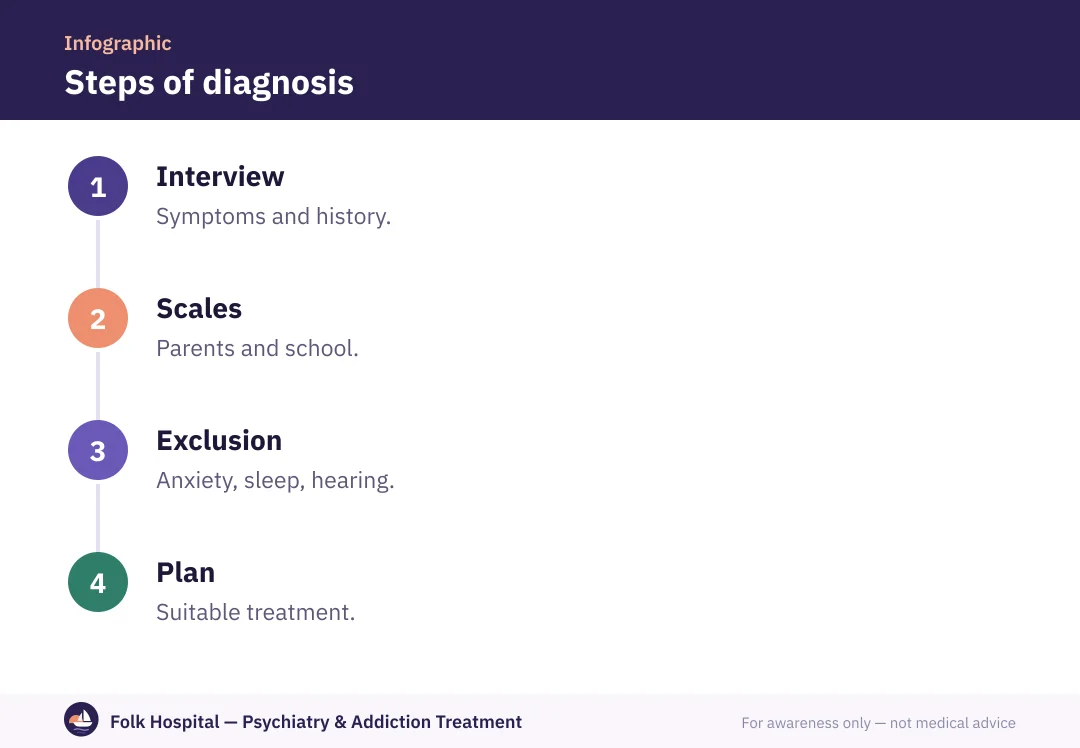
01Steps in diagnosis
- Interviewcurrent symptoms, when they started and where they appear.
- Standardised questionnairesfrom parents and teachers or relatives.
- Childhood reviewschool reports or family recollections.
- Medical checkhearing, vision and sleep.
- Excluding other conditionsanxiety, depression, learning difficulties, drugs.
- Treatment planaccording to presentation and age.
02Diagnostic requirements
| Requirement | Meaning |
|---|---|
| Number of symptoms | Six or more for children, five for those 17 and older, in the same group |
| Onset | Before age 12 |
| Setting | In at least two settings |
| Impact | Clear effect on study, work or relationships |
| Exclusion | Not due to another condition |
03Similar or co-occurring conditions
May resemble ADHD
- Learning difficulties.
- Anxiety and depression.
- Sleep loss or sleep apnoea.
- Hearing and vision problems.
- Effects of drugs.
May accompany it
- Autism.
- Oppositional defiance.
- Anxiety.
- Addiction in adults.
Read ADHD, its symptoms and the ADHD test.
؟Frequently asked questions
How is ADHD diagnosed?
Through a detailed interview, questionnaires from parents and teachers or relatives, a review of history since childhood, and excluding other conditions.
Is there a test for ADHD?
No blood test or scan diagnoses it; diagnosis is clinical.
At what age is ADHD diagnosed?
Usually at school age; it can be diagnosed in adulthood provided symptoms existed in childhood.
What conditions resemble ADHD?
Learning difficulties, anxiety, depression, sleep disorders, hearing and vision problems, autism and drug effects.
Can ADHD co-occur with other disorders?
Yes, often with learning difficulties, anxiety, oppositional behaviour or autism.
Is a self-test enough for diagnosis?
No. It's a screening tool; diagnosis needs specialist assessment.
Sources and references
- Attention-Deficit/Hyperactivity Disorder — National Institute of Mental Health (NIMH)
- Mental Health Medications — National Institute of Mental Health (NIMH)

A psychiatrist specialising in addiction and mental illness in adults and adolescents, with a focus on dual diagnosis.
For awareness only — not a substitute for medical advice. Editorial policy · View profile