
01Harms
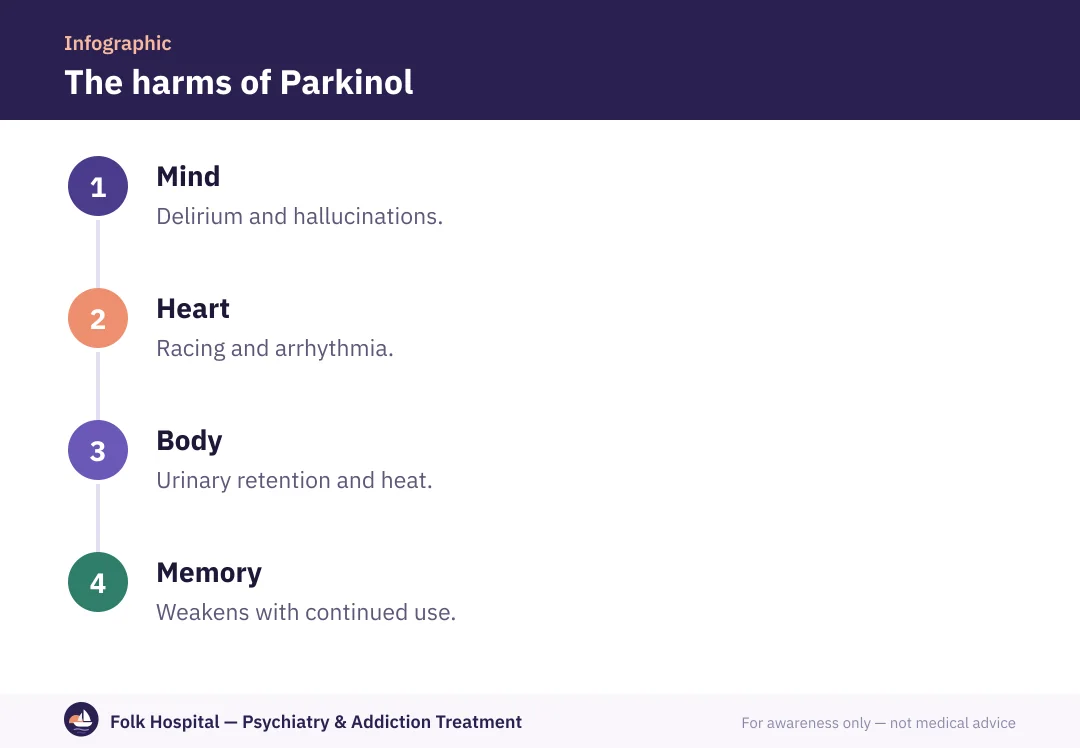
| Area | Harms |
|---|---|
| Toxicity | Confusion, hallucinations, agitation, fever and fast heartbeat |
| Eyes | Blurred vision, wide pupils, and risk for some glaucoma patients |
| Urine and digestion | Urinary retention and severe constipation |
| Memory | Weak memory and concentration |
| Heat | Reduced sweating and heatstroke risk |
| Dependence | Cravings and mood swings with misuse |
Call an ambulance on 123 for
- Severe confusion, hallucinations, high temperature, urinary retention or seizures.
What to do right nowAmbulance: 123
02Treatment
Reviewing psychiatric medicines with the doctor, and gradual reduction where there's misuse. Read about Parkinol symptoms, its withdrawal and its treatment.
؟Frequently asked questions
Does Parkinol damage memory permanently?
Long, high-dose use weakens it, and it usually improves after stopping, though recovery can take time.
Does Parkinol harm the eyes?
It can cause blurred vision and raise eye pressure in people predisposed to a certain type of glaucoma.
Does it affect memory?
Yes. It can weaken memory and concentration, especially at high doses or in older people.
Is it dangerous in hot weather?
It can reduce sweating, raising the risk of heatstroke.
Sources and references
- Prescription Medicines — research topic — National Institute on Drug Abuse (NIDA)
- Mental Health Medications — National Institute of Mental Health (NIMH)

Written byDr. Mahmoud ElsawyConsultant in psychiatry and addiction treatment
A psychiatrist specialising in addiction and mental illness in adults and adolescents, with a focus on dual diagnosis.
For awareness only — not a substitute for medical advice. Editorial policy · View profile