
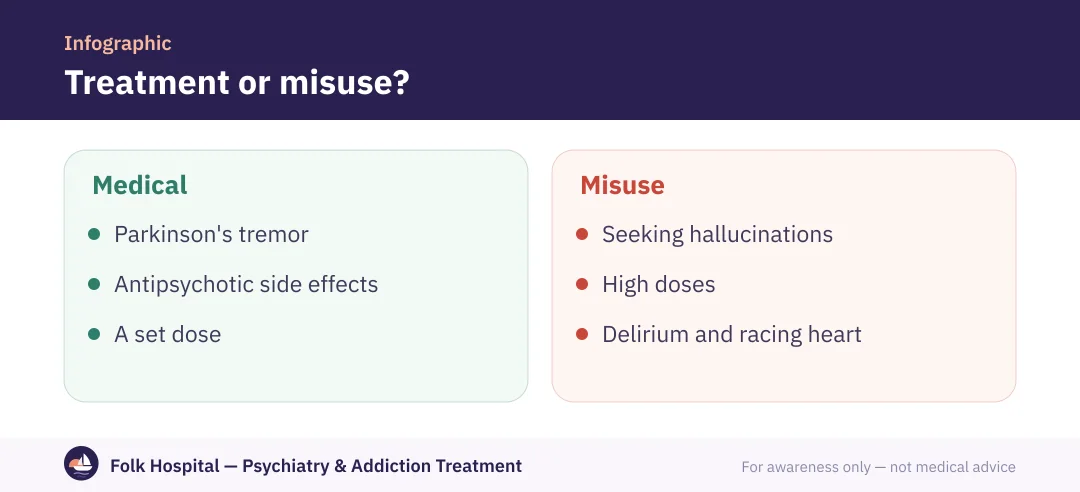
- Parkinol is an anticholinergic for Parkinson's disease and movement side effects of some psychiatric medicines.
- It's misused at high doses for a high or hallucinations.
- High doses cause toxicity and delirium.
Parkinol (trihexyphenidyl) is an important medicine for patients on antipsychotics, but it's sometimes misused for its effect on consciousness.
01Key facts
| Item | Details |
|---|---|
| Class | Anticholinergic |
| Common forms and names | Tablets |
| How it's used | By mouth |
| Does it show on a standard test? | No, it needs a specific test |
| Risk of dependence | Moderate with misuse |
02How does it affect the brain and body?
It blocks acetylcholine, easing stiffness and tremor, but high doses cause confusion, hallucinations, dryness, fast heartbeat and urinary retention.
03The main risks
- Toxicity and delirium.
- Urinary retention and constipation.
- Weak memory.
- Heatstroke from reduced sweating.
- Severe confusion or hallucinations.
- High temperature or urinary retention.
04What to read next
؟Frequently asked questions
Why is Parkinol misused?
Because at high doses it causes a high and hallucinations, and its low price and sometimes easy access helped it spread.
Can it be stopped suddenly?
Anyone using it medically with antipsychotics should see their doctor, because stopping suddenly can bring back movement symptoms.
Should I stop my prescribed Parkinol?
Don't stop it without the psychiatrist, as movement symptoms may return.
Why is it misused?
For a high or hallucinations at high doses, which is dangerous.
Sources and references
- Prescription Medicines — research topic — National Institute on Drug Abuse (NIDA)
- Mental Health Medications — National Institute of Mental Health (NIMH)

A psychiatrist specialising in addiction and mental illness in adults and adolescents, with a focus on dual diagnosis.
For awareness only — not a substitute for medical advice. Editorial policy · View profile