- Khat is tree leaves chewed for hours, containing cathinone.
- It's common in Yemen and the Horn of Africa, and criminalised in Egypt and many countries.
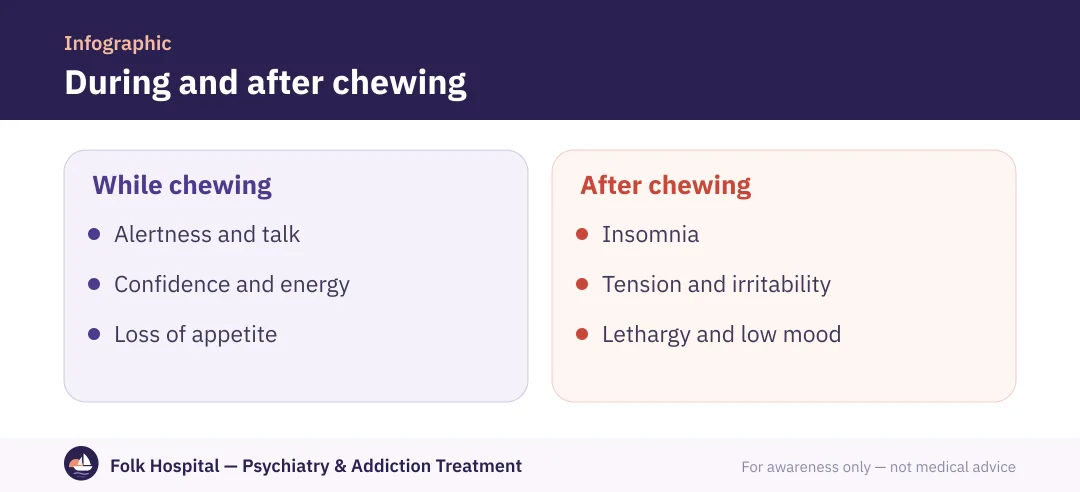
- It causes alertness and talkativeness, then insomnia and lethargy.
Khat is a social habit in some communities, but its active substance is a stimulant that causes psychological dependence and harms the heart, sleep and family.
01Key facts
| Item | Details |
|---|---|
| Class | Natural stimulant (cathinone) |
| Common forms and names | Fresh leaves |
| How it's used | Chewed and held in the mouth |
| Does it show on a standard test? | No, it needs a specific test |
| Risk of dependence | Psychological with daily use |
02How does it affect the brain and body?
Cathinone is absorbed gradually from the mouth, raising dopamine and noradrenaline more mildly than amphetamine, causing alertness and energy, then insomnia and lethargy.
03The main risks
- High blood pressure and fast heartbeat.
- Insomnia, anxiety and suspicion.
- Mouth, dental and digestive problems.
- Neglect of family and work.
- Chest pain or a very fast heartbeat.
- Hallucinations or severe suspicion.
04What to read next
؟Frequently asked questions
Is khat a drug?
It contains a stimulant that's a controlled substance in many countries, including Egypt, and it causes psychological dependence in many users.
Is khat addictive?
It causes psychological dependence and an urge to chew daily, and stopping brings temporary lethargy and low mood.
Is khat legal in Egypt?
It's criminalised in Egypt and many countries.
Does khat cause addiction?
It causes psychological dependence with daily use.
Sources and references
- Synthetic Cathinones (Bath Salts) DrugFacts — National Institute on Drug Abuse (NIDA)

A psychiatrist specialising in addiction and mental illness in adults and adolescents, with a focus on dual diagnosis.
For awareness only — not a substitute for medical advice. Editorial policy · View profile