Ecstasy gives a feeling of closeness and openness, so it attracts people seeking connection or escape from social anxiety.
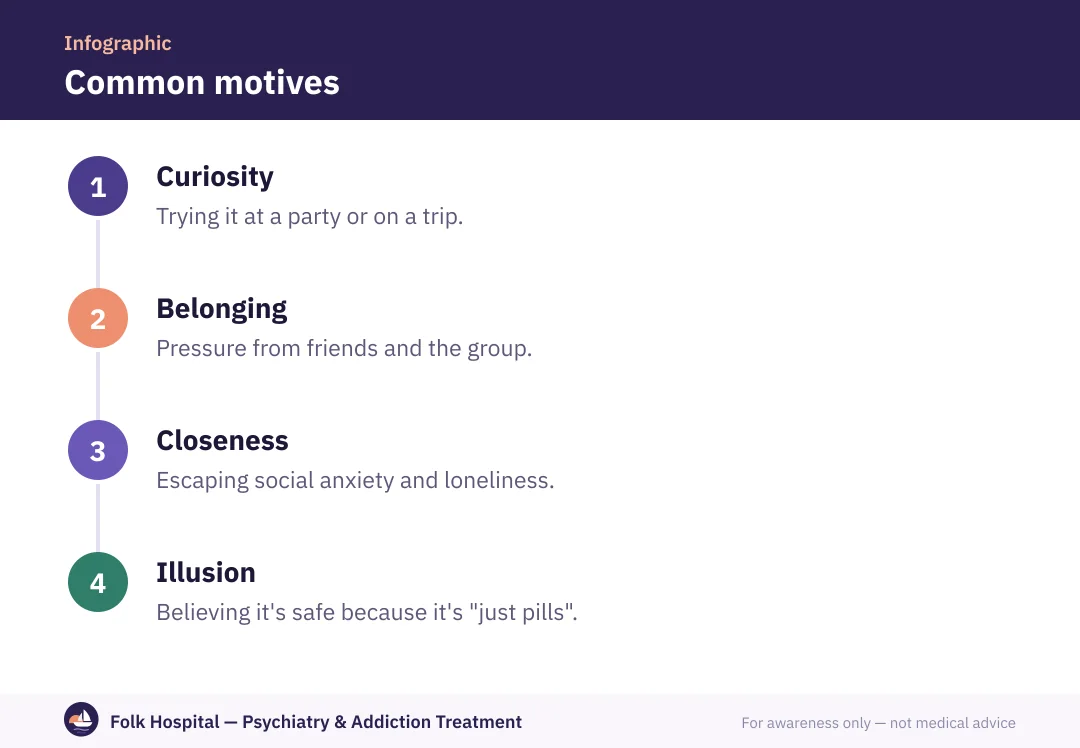
01Factors that raise the risk of addiction
| Factor | How it contributes |
|---|---|
| Party environment | Normalised use and easy access |
| Curiosity and friends | The first try is usually in a group |
| Social anxiety | Seeking confidence and openness |
| Loneliness and depression | Seeking a feeling of closeness |
| Believing it's safe | Underestimating its danger |
Having a risk factor doesn't make addiction inevitable, and lacking one doesn't guarantee protection; addiction is an illness with many causes, and it can be treated.
02How does use turn into addiction?
After each use comes a low, and use may repeat at every event. Over time the positive effect fades while the negative effect on mood and sleep grows.
03What protects?
- Treating anxiety, depression and insomnia early and safely.
- Supportive relationships and open conversation in the family.
- Healthy ways of coping with stress and pain.
- Seeking help at the first signs of losing control.
Read about ecstasy symptoms, its harms, its treatment.
؟Frequently asked questions
Can just once be harmless?
Nobody can guarantee that. The pill's contents are unknown, and overheating or low sodium can happen the first time.
Does ecstasy cause addiction?
It can cause psychological dependence in some people, and is often linked to other substances.
Why is it thought to be safe?
Because it's used at parties and seen as recreational, but the risks of overheating, the heart and adulterated pills are real.
Sources and references
- MDMA (Ecstasy/Molly) — research topic — National Institute on Drug Abuse (NIDA)
- Drugs, Brains, and Behavior: The Science of Addiction — National Institute on Drug Abuse (NIDA)
- MDMA (Ecstasy/Molly) — research topic — National Institute on Drug Abuse (NIDA)
- Drugs, Brains, and Behavior: The Science of Addiction — National Institute on Drug Abuse (NIDA)

A psychiatrist specialising in addiction and mental illness in adults and adolescents, with a focus on dual diagnosis.
For awareness only — not a substitute for medical advice. Editorial policy · View profile