01Why is it dangerous?
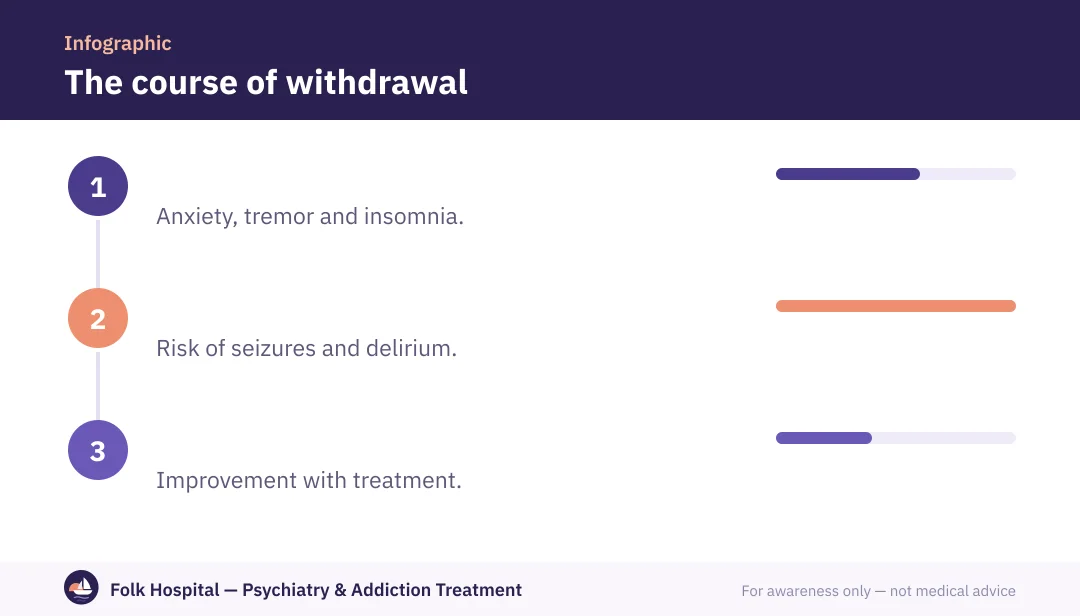
Barbiturates strongly calm the nervous system. With regular use the brain adapts to them, so stopping suddenly causes nervous overactivity that can lead to seizures, delirium and high temperature. Their danger is similar to, or greater than, that of alcohol and sedative withdrawal.
02Symptoms
| Severity | Symptoms |
|---|---|
| Mild to moderate | Anxiety, insomnia, tremor, sweating, nausea and weakness |
| Severe | Seizures, hallucinations, delirium, high temperature and irregular pulse |
03How is safe detox done?
- Hospital admissionfor continuous monitoring.
- Gradual reductionin doses set by the doctor, sometimes by switching to a longer-acting medicine.
- Monitoring vital signspulse, blood pressure, temperature and consciousness.
- Treating symptomsinsomnia and anxiety.
- A treatment plan after detoxto prevent a return.
- Stopping suddenly after regular use can be life-threatening. For seizures or severe confusion: ambulance 123 immediately.
Read about the harms of barbiturates, prescription drug addiction and detox.
؟Frequently asked questions
Can barbiturates be stopped at home?
We don't advise it. Withdrawal can be life-threatening and needs hospital monitoring.
When do withdrawal symptoms start?
It depends on the type of medicine and how long it acts, usually within one to three days of the last dose, with the first days the most dangerous.
How long does safe detox take?
The doctor sets the pace of reduction according to dose and duration, and it may take weeks with monitoring.
Are barbiturates still used?
Their medical use is now very limited, such as some cases of epilepsy and anaesthesia, but they're still sometimes misused.
Sources and references
- Prescription Medicines — research topic — National Institute on Drug Abuse (NIDA)
- Treatment Approaches for Drug Addiction — DrugFacts — National Institute on Drug Abuse (NIDA)
- Alcohol withdrawal — U.S. National Library of Medicine — MedlinePlus

A psychiatrist specialising in addiction and mental illness in adults and adolescents, with a focus on dual diagnosis.
For awareness only — not a substitute for medical advice. Editorial policy · View profile