01Why is addiction different for women?
Addiction affects men and women, but women's experience differs in important ways:
| Aspect | What's often different for women |
|---|---|
| Stigma | Much greater, so women hide the problem longer and delay asking for help |
| Speed of progression | Dependence may develop faster with some drugs, at lower doses and over a shorter time |
| Health harm | Some harm, such as liver disease with alcohol, may appear sooner |
| Causes | A stronger link with depression, anxiety, trauma and violence |
| Type of drug | Misuse of prescribed medicines such as sedatives and painkillers is common |
| Barriers | Childcare, fear of losing custody, and a husband or family who object |
02Common causes for women
- Depression and anxiety: especially after childbirth or during stressful periods. Read about postpartum depression.
- Trauma and violence: a history of abuse or domestic violence greatly raises the risk. Read about PTSD.
- Prescribed medicines: sedatives, sleeping pills or painkillers that started on prescription and then increased. Read sedative addiction treatment.
- A partner who uses: many women started using with a husband or partner.
- Accumulated pressure: the burdens of home, work and children without support.
- Body image: sometimes using stimulants to lose weight.
03Pregnancy and motherhood
A specific plan for pregnancy
If you're pregnant and using, seeking treatment is the best thing you can do for yourself and your baby. But don't stop suddenly without supervision, because stopping some drugs abruptly, such as opioids, can harm the baby. International guidance recommends a specialist medical plan, often stable medication treatment with obstetric follow-up. Read about drugs and pregnancy.
Many mothers fear seeking treatment because of their children. But treatment is a step to protect children, and we'll discuss childcare arrangements with you during treatment; outpatient care is a suitable option in some cases.
04How we meet women's needs in treatment
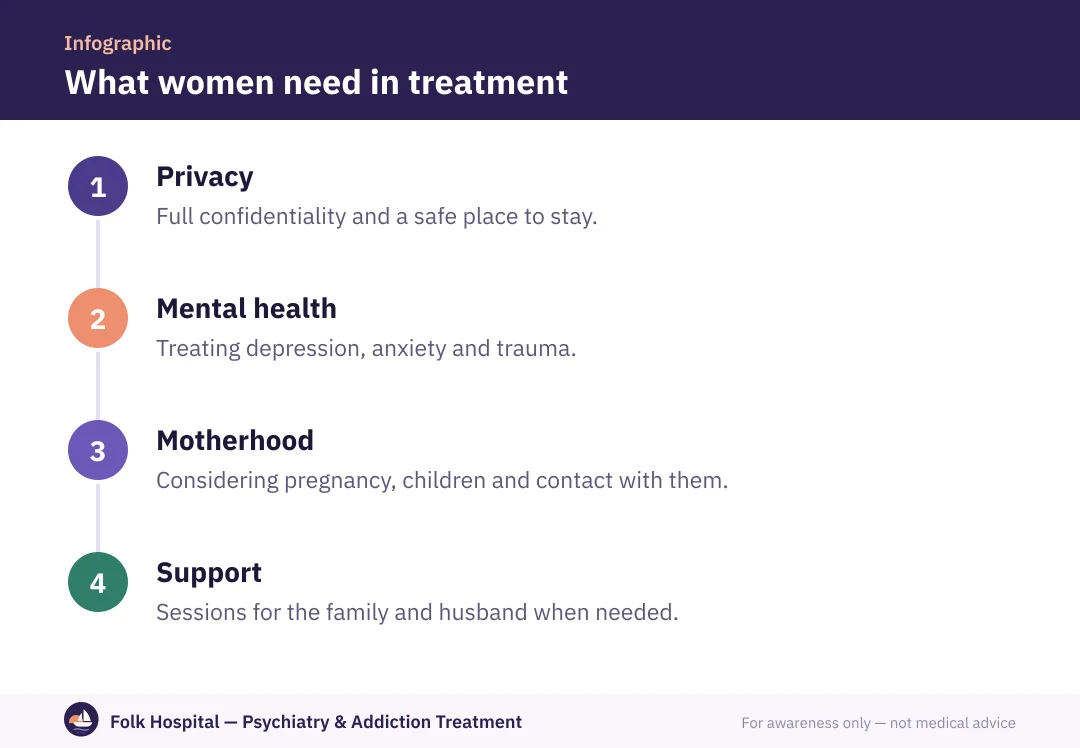
- Full confidentialitywe don't contact anyone without your permission.
- A comprehensive assessmentincluding trauma, violence, pregnancy and reproductive health.
- A safe settingthat respects privacy and dignity.
- Treating trauma and depressionbecause they often lie behind the use.
- Involving the family carefullyaccording to your wishes and safety, especially where there's violence.
- A plan for children and motherhoodchildcare arrangements and support in your role as a mother.
05If there's violence at home
Your safety comes first. If you're experiencing violence, it affects your treatment and recovery, and we'll help you make a safety plan. In immediate danger, call the police on 122 or an ambulance on 123.
؟Frequently asked questions
Is treatment for women confidential?
Completely. We know stigma falls harder on women, so we ensure full confidentiality and don't contact anyone without her permission.
Can addiction be treated during pregnancy?
Yes, and it's essential to protect mother and baby, but with a specialist plan; stopping some drugs suddenly, such as opioids, can harm the baby, and a stable medication plan with obstetric follow-up is often preferred.
I'm afraid my children will be taken if I ask for treatment. What should I do?
Seeking treatment is a step to protect your children, not the reverse. We'll discuss childcare arrangements during treatment, and outpatient care is an option in some cases.
Is there treatment specifically for women?
We take women's needs into account in the assessment and plan: privacy, trauma, pregnancy, motherhood and the marital relationship, in a safe and respectful setting.
Sources and references
- Treatment Approaches for Drug Addiction — DrugFacts — National Institute on Drug Abuse (NIDA)
- Co-Occurring Disorders and Health Conditions — National Institute on Drug Abuse (NIDA)
- Guidelines for the psychosocially assisted pharmacological treatment of opioid dependence — World Health Organization
- Mental disorders — fact sheet — World Health Organization

A specialist in psychological rehabilitation, behaviour modification and relapse prevention, with over 15 years in addiction programmes.
For awareness only — not a substitute for medical advice. Editorial policy · View profile