01Why does treatment falter?
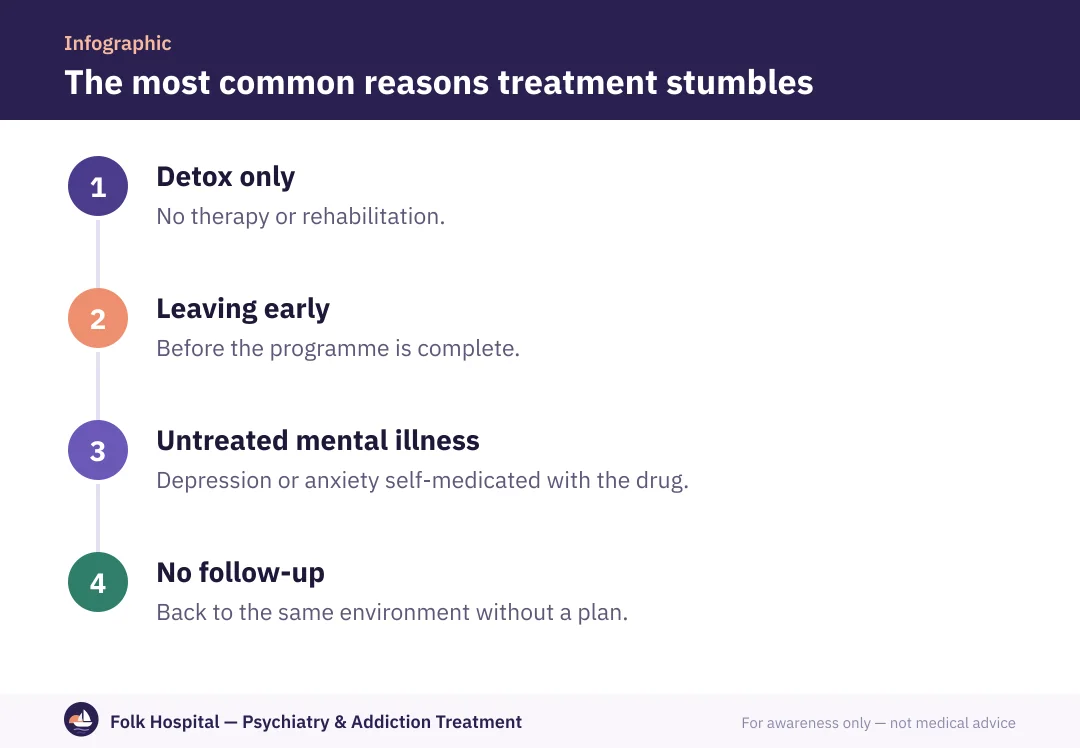
| Reason | Why it leads to a setback | The answer |
|---|---|---|
| Stopping at detox | Detox treats the body only; cravings and causes remain | Psychological rehabilitation after detox |
| Leaving early | Before skills are built and the person is stable | An adequate length set by assessment |
| Neglecting mental illness | Untreated depression and anxiety lead back to the drug | Integrated dual-diagnosis treatment |
| Returning to the same environment | The same friends, places and triggers | A clear plan for surroundings and friends |
| No follow-up | The first months are the riskiest | An aftercare programme for a year |
| No family involvement | Home hasn't changed or learned how to support | A family programme |
| Unsuitable treatment | Places relying on confinement and force without real treatment | Choosing a licensed place with a clear programme |
| Not using suitable medicines | For some drugs, medicines greatly reduce relapse | A medical assessment of medication options |
02Stopping at detox: the commonest mistake
Many families believe treatment means "cleaning the body" in a few days. But research shows that detox alone without rehabilitation is followed by relapse in most cases, because it doesn't treat cravings, habits or causes. Read about physical versus psychological dependence.
03Leaving early
Many patients feel much better physically after two weeks and ask to leave, thinking they're "done". Families sometimes agree to reduce cost. But staying in treatment long enough is one of the most important factors in success in research. Read about residential rehab.
04The forgotten mental illness
When depression, anxiety, trauma or bipolar disorder lies behind the addiction and only the addiction is treated, the pain that drove the use remains, and the person goes back to the drug. Read about dual diagnosis.
05What if you've had a setback before?
- Don't blame yourselfsetbacks are common in chronic illnesses and aren't proof of weakness.
- Understand what happenedwhich of the reasons above was behind your setback?
- Choose a fuller planrehabilitation, follow-up, and psychological and family treatment, not detox alone.
- Use the experiencewhat you learned last time helps you now.
- Start earlythe sooner you return to treatment, the easier it is.
Read about relapse and how to choose a treatment centre.
؟Frequently asked questions
Why do people relapse after leaving rehab?
Usually because treatment was limited to detox, was too short, didn't treat a co-existing mental illness, or the person returned to the same environment without a plan and follow-up.
Does a setback mean treatment is pointless?
No. Addiction is a chronic illness, and relapse is possible as with other chronic illnesses. A setback means the plan needs adjusting, not that treatment doesn't work.
What raises the chances of treatment succeeding?
Completing the programme, treating any co-existing mental illness, involving the family, regular follow-up after discharge, suitable medicines for some drugs, and changing surroundings and friends.
Sources and references
- Treatment Approaches for Drug Addiction — DrugFacts — National Institute on Drug Abuse (NIDA)
- Drug misuse in over 16s: psychosocial interventions (CG51) — National Institute for Health and Care Excellence (NICE)
- Co-Occurring Disorders and Health Conditions — National Institute on Drug Abuse (NIDA)

A specialist in psychological rehabilitation, behaviour modification and relapse prevention, with over 15 years in addiction programmes.
For awareness only — not a substitute for medical advice. Editorial policy · View profile