01Why does fear delay treatment?
Many people know they need treatment but put it off for months or years. The reason usually isn't unwillingness but fear. Fear is understandable, but most of these fears rest on outdated or exaggerated images of treatment.
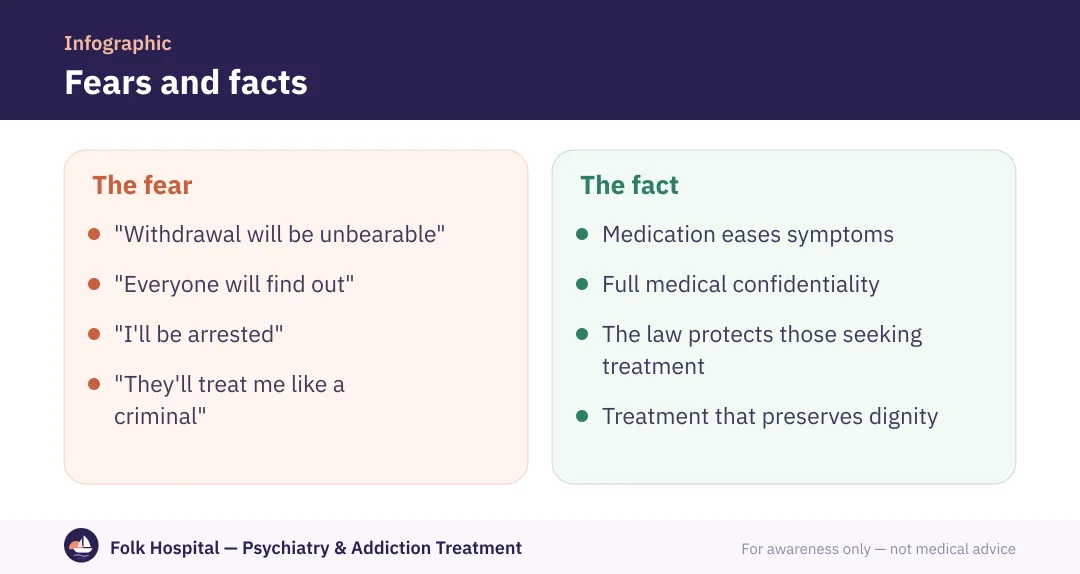
02The commonest fears, and the answers
| The fear | The reality |
|---|---|
| Withdrawal pain | Medical detox with medicines and monitoring greatly eases symptoms. Read about detox |
| Scandal | Medical information is confidential, and we don't contact anyone without your permission |
| Legal punishment | The law encourages voluntary treatment and protects those who come forward to the competent committee, under conditions. Read about the law |
| Losing your job | Treatment can be arranged to protect your work, and outpatient care is an option for some cases |
| Rehab itself | A licensed place respects dignity and doesn't use violence. Read how to choose |
| Life without the drug | Treatment teaches you how to handle stress, feelings and boredom without it |
| Psychiatric medicines | Most aren't addictive and are used with follow-up |
03Fear of life without the drug
This may be the deepest fear: "How will I sleep? How will I cope with stress? How will I be around people?" The drug has become your only tool for dealing with life, and losing it is frightening. Treatment doesn't take the tool away and leave you empty-handed; it gives you alternative tools: ways to sleep, skills to calm anxiety, ways to handle anger and sadness, and treatment for any depression or anxiety behind the use.
04What if the fear is of failing?
If you've tried before and gone back to using, you may fear it will happen again. But:
- Previous attempts aren't zero: you learned what does and doesn't work for you.
- Relapse is common in chronic illnesses and doesn't mean recovery is impossible. Read about relapse.
- Perhaps the plan was incomplete: detox without rehabilitation, leaving early, or an untreated mental illness. Read why treatment sometimes fails.
05Small steps that break the fear
- An enquiry callwith no commitment, ask about whatever worries you.
- An initial assessmentlearn about your situation and the options.
- Visiting the placeif you wish, before any decision.
- Talking with your familyabout your fears and what you need from them.
- The first stepwhen you're ready, with a plan you understand.
06For families: how to help someone who's afraid
Don't dismiss or mock their fears. Listen, ask what specifically frightens them, and look for answers together. Offer to join them on the first call or visit. Read how to convince someone to get treatment.
؟Frequently asked questions
I'm afraid of withdrawal pain. Will I suffer?
Withdrawal is real, but medical detox with medicines and monitoring eases it a great deal. What makes it torture is trying alone without treatment.
Will anyone know I'm in treatment?
No. Medical information is confidential, we don't contact anyone without your permission, and the law itself treats patient information held by those treating addiction as secret.
Will I be treated like a criminal in rehab?
In the right place, no. You're a patient receiving treatment, with rights to dignity, information and contact with your family. Avoid any place that relies on humiliation or violence.
I'm afraid I'll fail like I did before.
Previous attempts aren't complete failures; you learned from them. Recovery often takes more than one attempt, and each attempt with a better plan raises the chances of success.
Sources and references
- Treatment Approaches for Drug Addiction — DrugFacts — National Institute on Drug Abuse (NIDA)
- قانون رقم 182 لسنة 1960 في شأن مكافحة المخدرات (النص وفق آخر تعديل) — Egyptian law text
- Drug misuse in over 16s: opioid detoxification (CG52) — National Institute for Health and Care Excellence (NICE)

A specialist in psychological rehabilitation, behaviour modification and relapse prevention, with over 15 years in addiction programmes.
For awareness only — not a substitute for medical advice. Editorial policy · View profile