01Physical harm
| System | Possible harm |
|---|---|
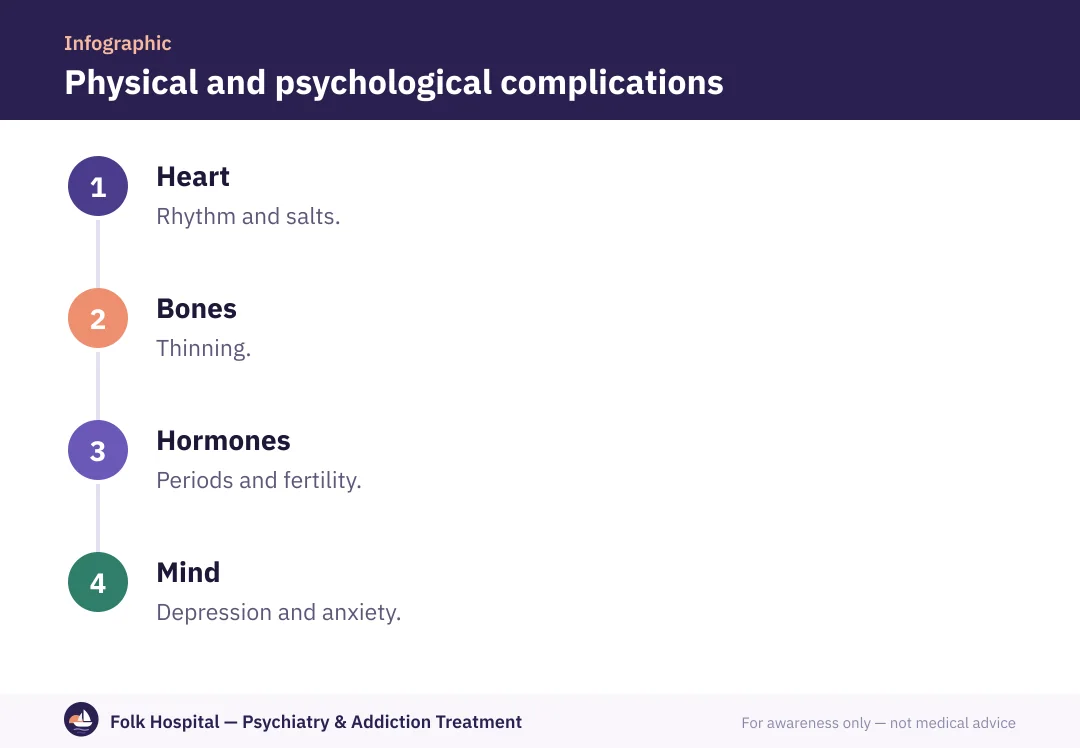
| Heart | Slow or irregular beat |
| Electrolytes | Low potassium and sodium |
| Bones | Early thinning |
| Hormones | Disrupted periods and fertility |
| Digestion | Constipation, reflux, oesophagitis |
| Teeth | Enamel erosion |
02Psychological and social harm
May appear
- Depression and anxiety.
- Isolation and avoiding social events.
- Falling behind at school or work.
- Strained family relationships.
- Self-harm at times.
- Fainting, severe dizziness, palpitations or chest pain.
- Repeated vomiting with severe weakness or confusion.
- Suicidal thoughts or self-harm.
In Egypt call the ambulance on 123 immediately, or the mental-health hotline 08008880700.
Ambulance: 123Read eating disorders and their treatment, and try the eating disorders test. Also read depression.
؟Frequently asked questions
What harm do eating disorders cause?
Damage to the heart, electrolytes, bones, hormones, digestion, teeth and brain, plus psychological and social harm.
Do complications affect people at a normal weight?
Yes, especially with vomiting or laxatives; risk isn't tied to weight alone.
Do eating disorders affect fertility?
Periods and hormones can be disrupted and usually improve with recovery.
Is the damage permanent?
Much of it improves with treatment; some, like bone thinning, may need long follow-up.
What is the psychological harm?
Depression, anxiety, isolation and sometimes suicidal thoughts needing urgent help.
When should I go to emergency?
With fainting, chest pain, palpitations, severe weakness or confusion.
Sources and references
- Eating Disorders — National Institute of Mental Health (NIMH)
- Anorexia — overview — NHS (UK)
- Bulimia — overview — NHS (UK)
- Binge eating disorder — NHS (UK)

A psychiatrist specialising in addiction and mental illness in adults and adolescents, with a focus on dual diagnosis.
For awareness only — not a substitute for medical advice. Editorial policy · View profile