01The main harms
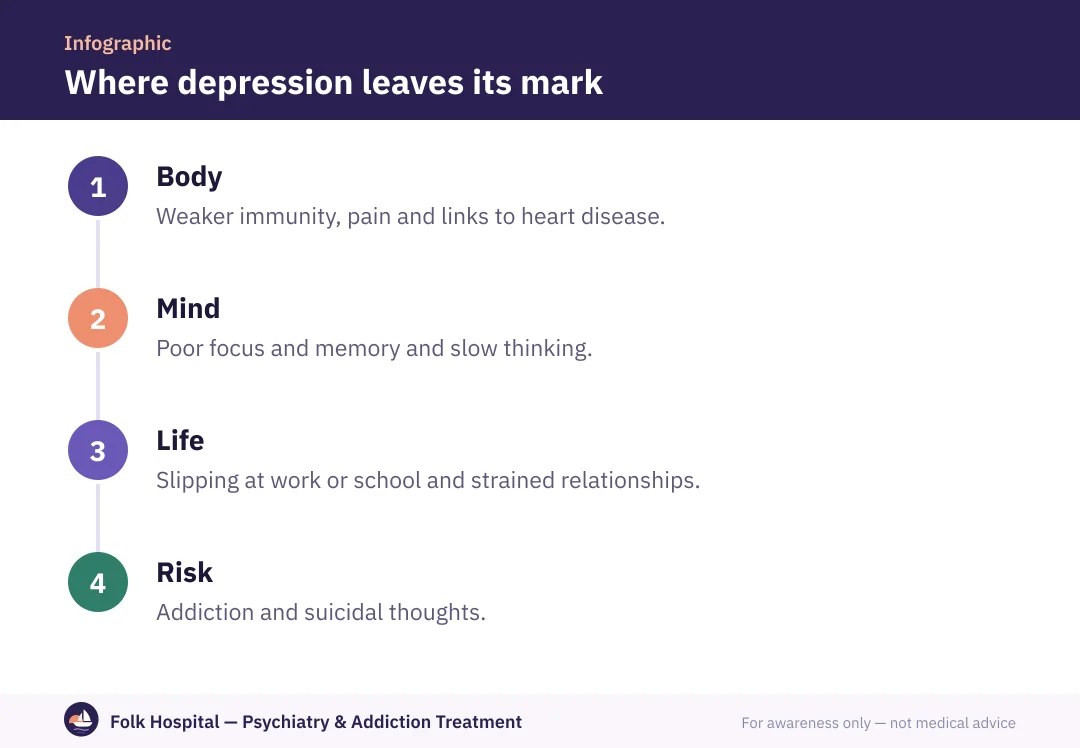
| Area | Harm |
|---|---|
| Life | Risk of suicide |
| Work and study | Decline, absences and job loss |
| Family | Withdrawal, irritability, effects on children |
| Substances | Addiction to alcohol or sedatives |
| Body | Weaker immunity, heart disease, chronic pain |
| Mind | Poorer memory and concentration |
02The effect on children at home
What children may notice
- An emotionally absent parent.
- Irritability or sadness they don't understand.
- Fewer shared activities.
- Guilt or a sense of responsibility.
- Suicidal thoughts or plans, or self-harm.
- Stopping eating and drinking or being unable to care for oneself.
- Hallucinations or strange beliefs with depression.
Mental health hotline 08008880700; ambulance 123.
Ambulance: 12303Treatment reduces the harms
- Safetya clear plan for suicidal thoughts.
- Treatmentpsychological and medical according to severity.
- Continuingafter improvement to prevent relapse.
- Treating co-occurring problemsaddiction and physical illness.
Read depression, depression relapse and depression treatment.
؟Frequently asked questions
What's the most serious harm of depression?
Suicide, so any talk of death or self-harm must be taken seriously and help sought immediately.
Does depression harm the body?
Yes. It's linked to weaker immunity and higher heart disease risk, and makes chronic illness harder to control.
Does depression affect memory?
Yes. It can cause poor concentration and memory, which usually improve with treatment.
Does depression lead to addiction?
It can drive the use of alcohol or sedatives for numbing, raising the risk of dependence.
How does depression affect the family?
Through withdrawal, irritability and low energy, affecting partner and children.
Do the harms go away with treatment?
Most improve with treatment, and early treatment reduces the risk of future episodes.
Sources and references
- Depressive disorder (depression) — fact sheet — World Health Organization
- Depression — National Institute of Mental Health (NIMH)
- Psychotherapies — National Institute of Mental Health (NIMH)

A psychiatrist specialising in addiction and mental illness in adults and adolescents, with a focus on dual diagnosis.
For awareness only — not a substitute for medical advice. Editorial policy · View profile