Cocaine leaves the blood quickly, but the body converts it into by-products that stay in urine for days, which is what tests look for.
01Detection window by sample type
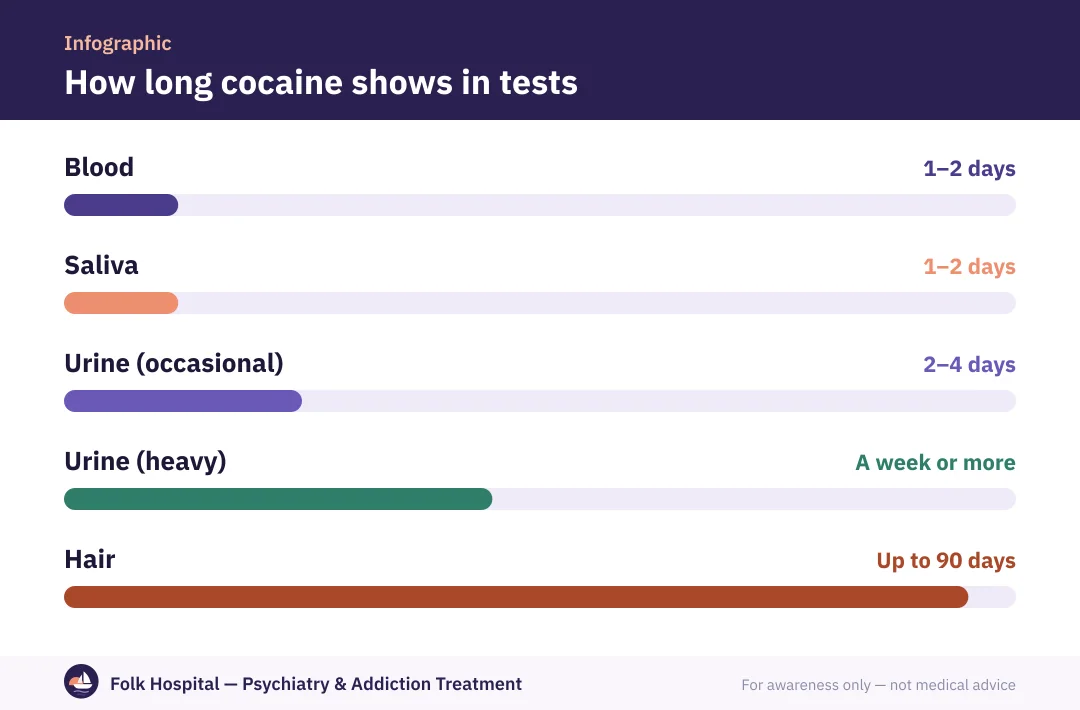
| Sample | Approximate window |
|---|---|
| Urine | Usually 2–4 days, a week or more with heavy use |
| Blood | One to two days |
| Saliva | One to two days |
| Hair | Up to about 90 days |
Times are approximate and vary from person to person; lab confirmation is the reference.
02Does it show on a standard test?
Yes, the cocaine panel detects it on most tests, and it's relatively precise with few false positives.
03What makes the window longer or shorter?
- Dose, frequency and length of use.
- Liver and kidney function.
- Age, weight and body fat.
- The type and sensitivity of the test.
There is no magic method
Detox drinks and drinking huge amounts of water don't speed up clearance and can be dangerous. Read about drug cleanse myths.
Read about cocaine symptoms, its withdrawal, its harms, crack.
؟Frequently asked questions
Does cocaine show in a standard drug test?
Most common test panels include cocaine. Check which test is required.
Does crack stay as long as cocaine?
Yes, roughly the same by-products, with the window depending on amount and frequency.
Does mixing it with alcohol change the test?
An extra compound forms that can be detected, and it increases the danger to the heart.
Sources and references
- Cocaine — research topic — National Institute on Drug Abuse (NIDA)
- Drug Testing — U.S. National Library of Medicine — MedlinePlus

A psychiatrist specialising in addiction and mental illness in adults and adolescents, with a focus on dual diagnosis.
For awareness only — not a substitute for medical advice. Editorial policy · View profile