01Signs
| Type | Signs |
|---|---|
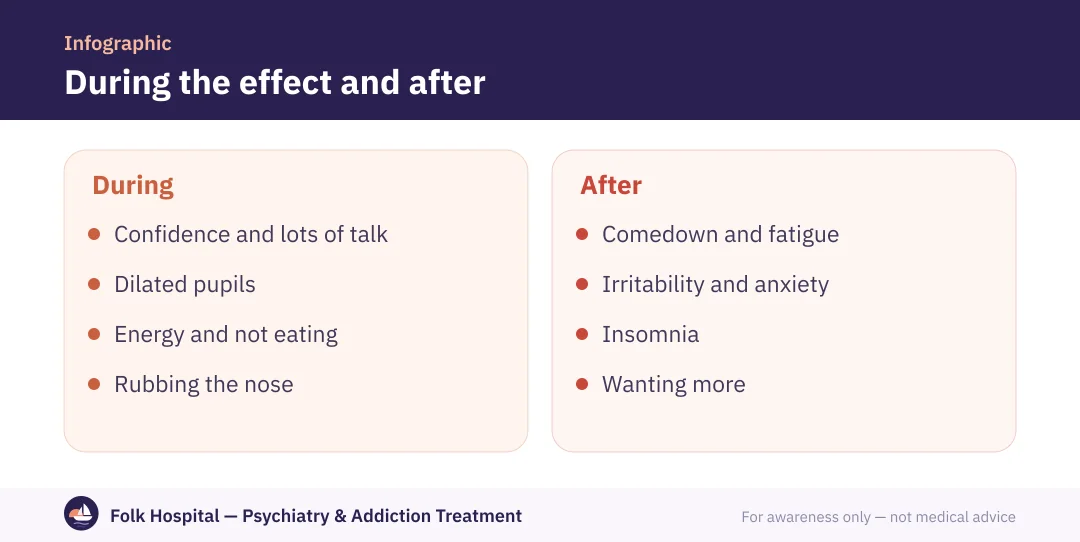
| Under the effect | Excess confidence, lots of talk, energy, wide pupils, sweating, fast heartbeat and loss of appetite |
| After the effect | A crash, irritability, anxiety and strong craving to repeat |
| With repeated snorting | Runny or bleeding nose, loss of smell and nasal sores |
| Behavioural | Heavy spending, missing money, late nights, new friends and secrecy |
02Danger signs
- Chest pain, breathlessness or a very fast heartbeat.
- A sudden severe headache or weakness on one side of the body.
- High temperature, seizures or severe agitation.
03What should you do?
Talk calmly about the facts and suggest a medical assessment that includes the heart. Read about cocaine withdrawal, its treatment, its harms and crack.
؟Frequently asked questions
Does a constantly runny nose mean cocaine use?
Not necessarily; allergies are common. But with repeated nosebleeds and other signs such as spending, late nights and changed behaviour, it deserves attention.
Why is cocaine used repeatedly in the same night?
Because its effect is short and followed by a crash and strong craving, so people take repeated doses, increasing the risk to the heart and of overdose.
Is mixing cocaine with alcohol dangerous?
Yes. A compound forms in the body that puts more strain on the heart and liver and raises the risk of sudden death.
What are the signs of crack?
Smoking with glass pipes, burns on fingers and lips, coughing, and a shorter, stronger effect than snorting. See the crack page.
Sources and references
- Cocaine — research topic — National Institute on Drug Abuse (NIDA)
- Drugs, Brains, and Behavior: The Science of Addiction — National Institute on Drug Abuse (NIDA)

A psychiatrist specialising in addiction and mental illness in adults and adolescents, with a focus on dual diagnosis.
For awareness only — not a substitute for medical advice. Editorial policy · View profile