01What is crack?
Cocaine in its usual form is a white salt that's snorted and can't be smoked because heat destroys it. Crack is cocaine converted into a heat-stable «base», appearing as crystals or small rocks smoked in pipes. Its name comes from the crackling sound it makes when heated.
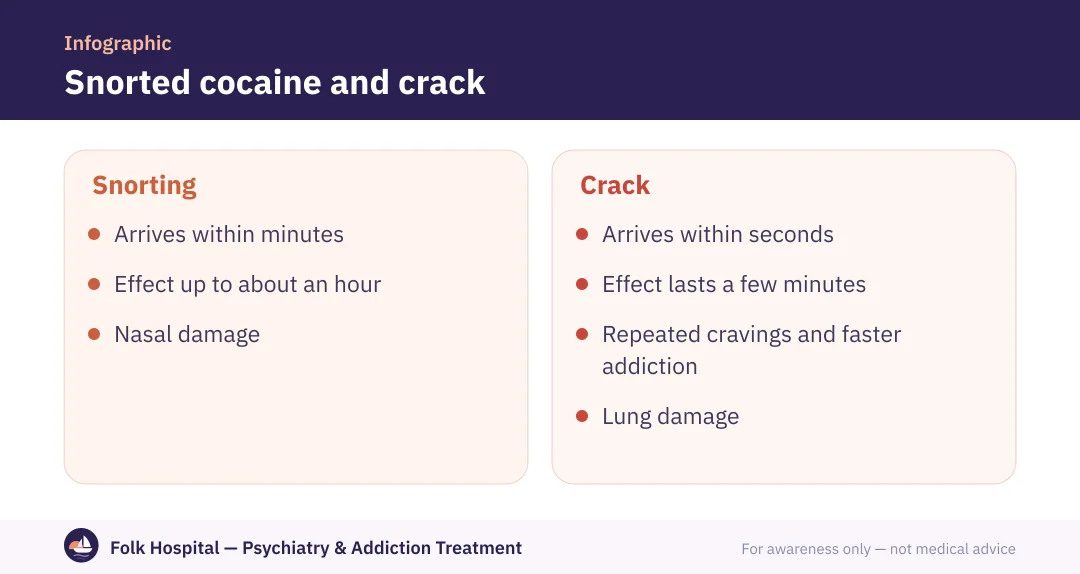
02Why is it more addictive than snorted cocaine?
| Snorted cocaine | Smoked crack | |
|---|---|---|
| Onset | Minutes | Seconds |
| Length of high | Roughly 15–30 minutes | Roughly 5–10 minutes |
| Pattern of use | Spaced doses | Back-to-back «binges» |
| Speed of dependence | Fast | Faster |
The faster a drug reaches the brain and the faster it fades, the stronger the link between drug and reward and the stronger the urge to repeat it. That's why people using crack go on binges lasting hours or days until the drug or money runs out.
03Signs of crack use
Common signs
- Small glass pipes or lighters burnt at the tip.
- Burns on the lips or fingers.
- Staying awake for days, then sleeping for long periods.
- Rapid weight loss.
- Irritability, suspicion and aggression.
- A chronic cough with dark phlegm.
04The harms of crack
- Heart and blood vessels: rhythm problems, heart attacks and strokes, even in young people.
- Lungs: coughing, breathlessness, chest pain and lung bleeding.
- Brain and mind: psychosis with hallucinations and suspicion, deep depression after binges, and suicidal thoughts.
- Seizures at high doses.
- Life: heavy spending, legal trouble and broken relationships.
- Chest pain or severe breathlessness.
- Seizures or loss of consciousness.
- High temperature with agitation.
- Sudden weakness on one side or difficulty speaking.
Don't try to restrain the person forcefully; keep them somewhere calm and cool until the ambulance arrives.
Ambulance: 12305Withdrawal and treatment
Crack withdrawal is mostly psychological: a crash with exhaustion and long sleep, then low mood and strong cravings that can last weeks. There's still no approved medicine for cocaine addiction, so treatment rests on:
- Assessmentheart and lung checks, and a psychiatric assessment for depression, psychosis and suicide risk.
- Managing withdrawaltreating insomnia and depression, with close follow-up in the first weeks.
- Rehabilitationcognitive behavioural therapy, contingency management and support groups.
- Follow-upa relapse-prevention plan involving the family and a change of environment.
Read cocaine addiction treatment, cocaine withdrawal and cocaine harms.
؟Frequently asked questions
What is crack?
A form of cocaine converted into crystals or small rocks that can be smoked, reaching the brain faster than snorting.
What's the difference between crack and cocaine?
The active substance is the same, but cocaine is a powder usually snorted, while crack is smoked, so its effect is faster and shorter and addiction comes sooner.
Why is crack so addictive?
The effect arrives in seconds and fades in minutes, so the brain forms a strong link between the drug and reward, and the person repeats the dose again and again.
Is crack common in Egypt?
It's less common than tramadol, hashish or shabu, but it exists, and its harms and treatment resemble cocaine's.
How does crack harm the lungs?
It can cause coughing, breathlessness, chest pain, lung bleeding and a condition known as «crack lung», plus burns to the mouth and lips.
Is there treatment for crack addiction?
Yes. Psychological and behavioural treatment works, especially contingency management and cognitive behavioural therapy, with treatment of related symptoms and long follow-up.
Sources and references
- Cocaine — research topic — National Institute on Drug Abuse (NIDA)
- Commonly Used Drugs Charts — National Institute on Drug Abuse (NIDA)
- Drugs, Brains, and Behavior: The Science of Addiction — National Institute on Drug Abuse (NIDA)

A psychiatrist specialising in addiction and mental illness in adults and adolescents, with a focus on dual diagnosis.
For awareness only — not a substitute for medical advice. Editorial policy · View profile