Cocaine often starts «on occasions» within certain social circles, but its strong, short effect makes repetition quick.
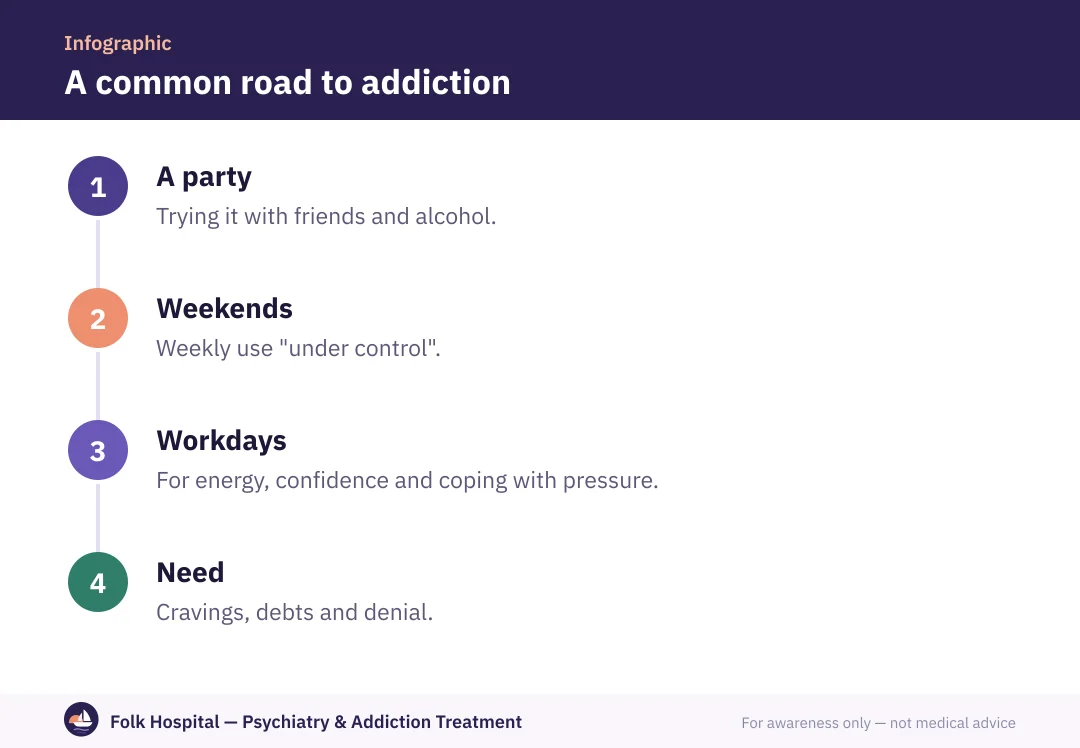
01Factors that raise the risk of addiction
| Factor | How it contributes |
|---|---|
| Social environment | Parties and circles that normalise use |
| Work pressure | Seeking energy and confidence |
| Mental disorders | Depression, anxiety and ADHD |
| Money and access | Being able to buy it increases repetition |
| Alcohol | Mixing is common and increases cravings |
Having a risk factor doesn't make addiction inevitable, and lacking one doesn't guarantee protection; addiction is an illness with many causes, and it can be treated.
02How does use turn into addiction?
Cocaine gives a strong high for minutes, then a crash and urgent craving, so use repeats within hours. The brain links cocaine with places, people and feelings, and these triggers spark cravings later.
03What protects?
- Treating anxiety, depression and insomnia early and safely.
- Supportive relationships and open conversation in the family.
- Healthy ways of coping with stress and pain.
- Seeking help at the first signs of losing control.
Read about cocaine symptoms, its harms, its treatment.
؟Frequently asked questions
I only use cocaine on occasions. Is that a problem?
It may be the start of one. If the occasions or amounts grow, or saying no gets harder, those are signs worth an early assessment.
Is using only on occasions safe?
No. The risk to the heart exists from the first time, and repetition can develop into addiction.
Why is it linked to alcohol?
Because some use it to stay alert while drinking, and this mixture increases the danger.
Sources and references
- Cocaine — research topic — National Institute on Drug Abuse (NIDA)
- Drugs, Brains, and Behavior: The Science of Addiction — National Institute on Drug Abuse (NIDA)
- Cocaine — research topic — National Institute on Drug Abuse (NIDA)
- Drugs, Brains, and Behavior: The Science of Addiction — National Institute on Drug Abuse (NIDA)

A psychiatrist specialising in addiction and mental illness in adults and adolescents, with a focus on dual diagnosis.
For awareness only — not a substitute for medical advice. Editorial policy · View profile