01What is the PHQ-9?
A nine-question scale covering the core symptoms of depression, widely used to screen for depression, estimate severity and track response to treatment. Each answer scores 0 to 3, for a total of 0 to 27.
02How do you read your score?
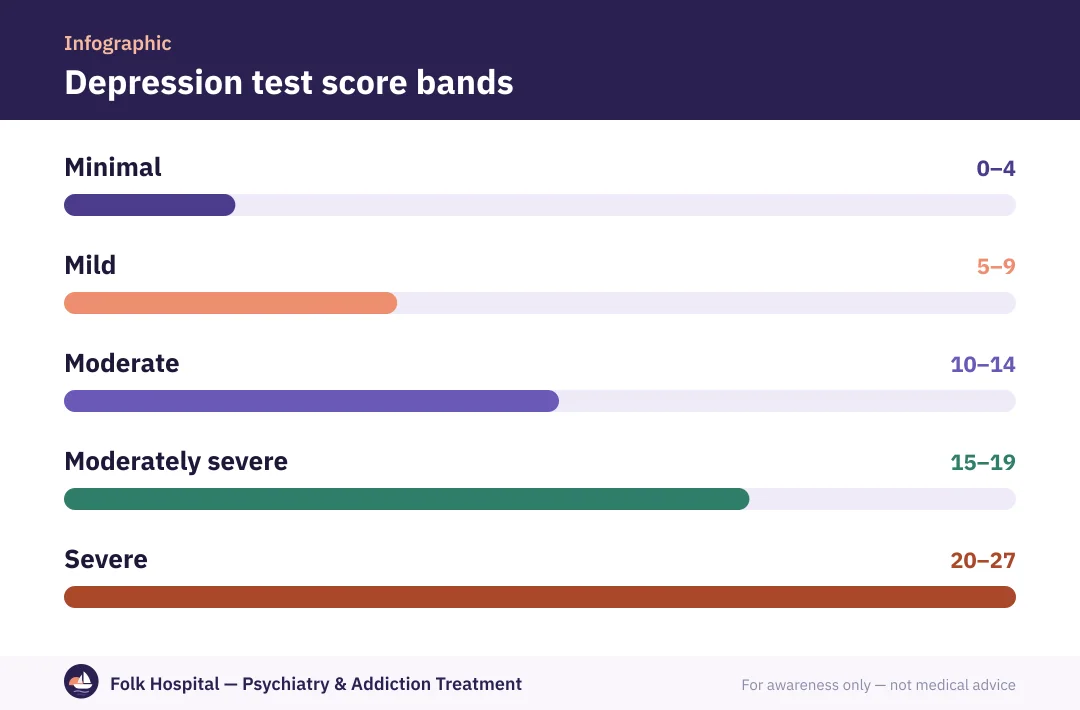
| Score | Level |
|---|---|
| 0–4 | Minimal |
| 5–9 | Mild |
| 10–14 | Moderate |
| 15–19 | Moderately severe |
| 20–27 | Severe |
More important than the number is the last question: any answer other than "Not at all" about thoughts of death or self-harm deserves talking to a specialist straight away. Read about depression.
03What the score means in practice
| Score | What's usually advised |
|---|---|
| 0–4 | Self-monitoring |
| 5–9 | Regular sleep and activity, then retest |
| 10–14 | Specialist assessment |
| 15–27 | Active treatment soon |
- Mind question nineany thoughts of death deserve a conversation today.
- Avoid alcohol and sedativesthey deepen symptoms.
- Tell someone closedon't carry this alone.
- Book an assessmentif you score 10 or more.
- Suicidal thoughts or intent to harm yourself or others.
- Losing touch with reality or severe agitation.
In Egypt call the ambulance on 123 or the mental-health hotline 08008880700.
Ambulance: 123؟Frequently asked questions
Is the depression test accurate?
The PHQ-9 is a validated, reliable screening tool, but it doesn't diagnose on its own. A doctor adds an interview that considers history and other causes.
How often can I retake the test?
You can retake it every two weeks to track change, which is what doctors do to monitor response to treatment.
I got a high score. What should I do?
Don't panic about the number alone, but take it seriously: book an assessment with a psychiatrist. If you have thoughts of self-harm, seek help immediately.
Why is question nine important?
Any answer other than «not at all» about thoughts of death or harm warrants talking to a specialist, whatever the score.
Does alcohol ease depression?
Briefly perhaps, but it deepens depression long-term.
How often should I retake it?
Every two weeks to track change, especially during treatment.
Is the test enough for diagnosis?
No. Diagnosis needs an interview to rule out other causes such as thyroid problems.
Sources and references
- Depression — National Institute of Mental Health (NIMH)
- Depressive disorder (depression) — fact sheet — World Health Organization
- Low mood, sadness and depression — NHS (UK)

A psychiatrist specialising in addiction and mental illness in adults and adolescents, with a focus on dual diagnosis.
For awareness only — not a substitute for medical advice. Editorial policy · View profile