01Signs of a problem
Signs of a problem
- Watching more than planned.
- Repeated late nights.
- Putting off work or study.
- Guilt afterwards.
- Watching to escape feelings.
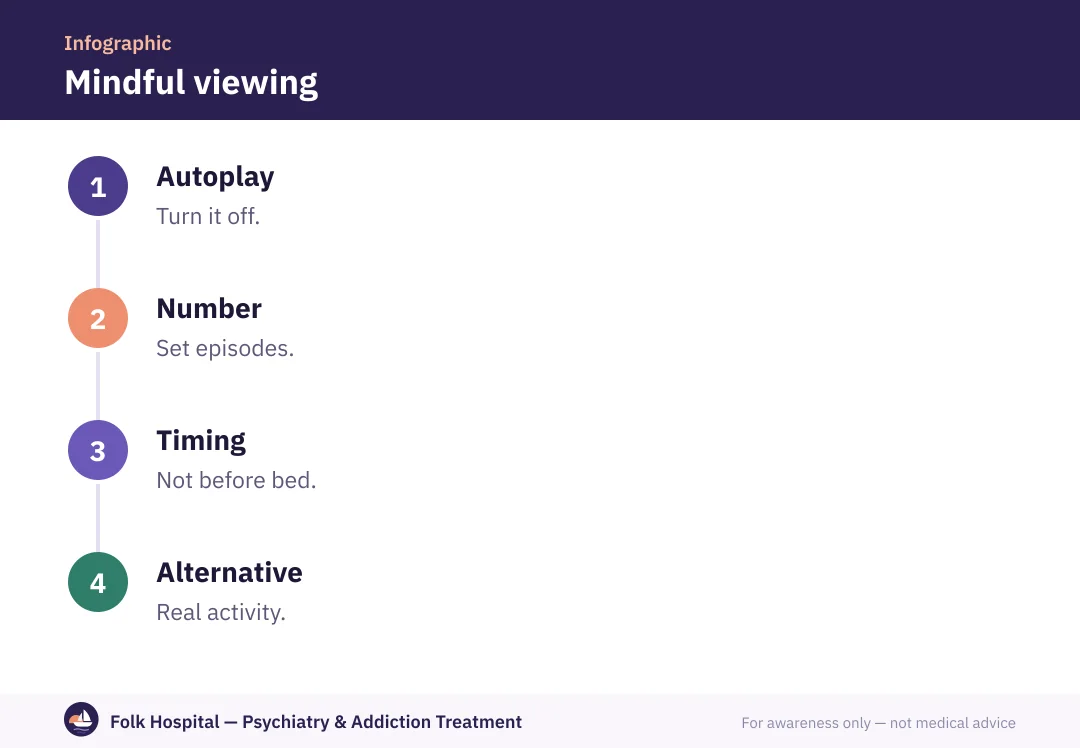
02Managing viewing
- Turn off autoplayin settings.
- Decide in advancethe number of episodes.
- An end timean hour before bed.
- Watch togetherinstead of isolating.
Read also: screen addictions, sleep disorders, loneliness.
؟Frequently asked questions
What is binge-watching?
Watching many episodes in a row without stopping.
Is it an addiction?
Not a diagnosis, but it can become a disabling compulsive pattern.
What are its harms?
Late nights, inactivity, putting off responsibilities and isolation.
Why is it hard to stop?
Autoplay and cliffhangers remove the stopping point.
Is it linked to depression?
It can be an escape from depression or loneliness and worsen them.
How do I control it?
Turn off autoplay, set the number of episodes and an end time.
Sources and references
- Social Media and Youth Mental Health — U.S. Surgeon General's Advisory — U.S. Surgeon General
- Sleep problems — Every Mind Matters — NHS (UK)

Written byDr. Mohamed HosneyConsultant in mental health and behavioural rehabilitation
A specialist in psychological rehabilitation, behaviour modification and relapse prevention, with over 15 years in addiction programmes.
For awareness only — not a substitute for medical advice. Editorial policy · View profile