01What does the faith say about seeking treatment?
The Prophet ﷺ encouraged seeking treatment, saying in a hadith: "Seek treatment, for God has not created a disease without creating a cure for it." And the Quran says: "Do not throw yourselves into destruction" (Al-Baqarah 2:195). So seeking treatment for addiction is taking the means and preserving life.
From this perspective, there's no conflict between faith and medical and psychological treatment; indeed, many people in recovery see their faith as one of the greatest helps in sticking with treatment and not going back.
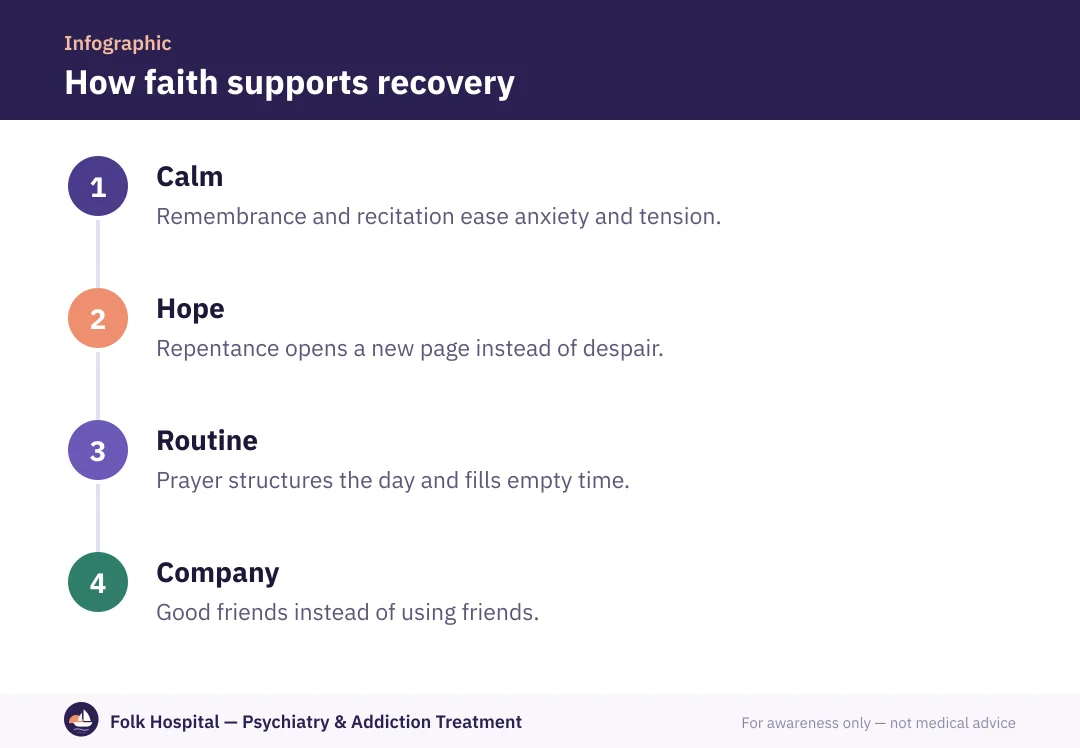
02How does faith help recovery?
| Aspect | How it helps |
|---|---|
| Meaning and motivation | Gives a deeper reason to change beyond fear of consequences |
| Structuring the day | Prayer times give the day a steady rhythm that fills empty time |
| Facing cravings | Remembrance, prayer, ablution and going to the mosque are practical alternatives in a weak moment |
| Calm | Easing anxiety and the sense of being alone |
| Good company | A new community away from using friends |
| Hope and repentance | The sense that the door is open whatever the past |
03How to combine faith and treatment
- Accept treatmentand see it as part of your repentance and taking the means.
- Make time for the spiritregular daily prayer and reading.
- Let go of crushing guiltremorse drives change; despair drives using.
- Choose supportive companyat the mosque and in recovery groups.
- Stick with the medical planmedicines, sessions and follow-up are part of taking the means.
04Guilt and shame: when do they harm?
Many patients carry heavy guilt about what they did during their addiction. Healthy remorse is useful, because it drives change and making amends. But when it turns into despair, self-contempt and "I don't deserve it", it becomes a reason to go back to using to escape the pain. Psychological therapy helps turn that guilt into strength for repair instead of a chain.
05A warning about unsafe alternatives
Be careful
Ruqya and prayer bring comfort, but relying on them alone and abandoning medical treatment can be dangerous, especially with alcohol, sedatives and high-dose opioids, whose withdrawal needs medical supervision. Beware of any place that uses beating, confinement or deprivation in the name of religion; that isn't treatment and doesn't fit the mercy the faith calls for.
06Spiritual support at Folk
We respect every patient's religious values, and spiritual support can be part of their plan: time for prayer in their day, encouragement for practices that bring them calm, and connection with supportive company after discharge. All of this sits alongside medical and psychological treatment. Read about the 12-step programme and cravings.
؟Frequently asked questions
Is ruqya enough to treat addiction?
Ruqya and prayer bring comfort and strength, but addiction is an illness with withdrawal and changes in the brain that need medical treatment, and the faith itself calls for seeking treatment.
Does psychological treatment conflict with faith?
No. Psychological and medical treatment are taking the means, and many people in recovery find their faith helped them stick with treatment.
I feel great guilt about what I did during my addiction. How do I cope?
Healthy remorse drives change and making amends, but crushing guilt that leads to despair needs treatment and support, because it's a cause of going back to using. Repentance and making amends are open doors.
Can spiritual support be part of my plan at Folk?
Yes. We respect every patient's religious values, and the spiritual practices they wish can be built into their daily routine and recovery plan.
Sources and references
- Treatment Approaches for Drug Addiction — DrugFacts — National Institute on Drug Abuse (NIDA)
- Drug misuse in over 16s: psychosocial interventions (CG51) — National Institute for Health and Care Excellence (NICE)
- Mental disorders — fact sheet — World Health Organization
A specialist in psychological rehabilitation, behaviour modification and relapse prevention, with over 15 years in addiction programmes.
For awareness only — not a substitute for medical advice. Editorial policy · View profile