01Psychological or physical?
| Sign | Leans psychological | Needs urgent check |
|---|---|---|
| Timing | With anxiety and stress | With exertion or at night |
| Accompanying | Tingling and dizziness | Chest pain, wheeze, blue lips |
| Response to calming | Improves | Doesn't improve |
02Breathing exercise
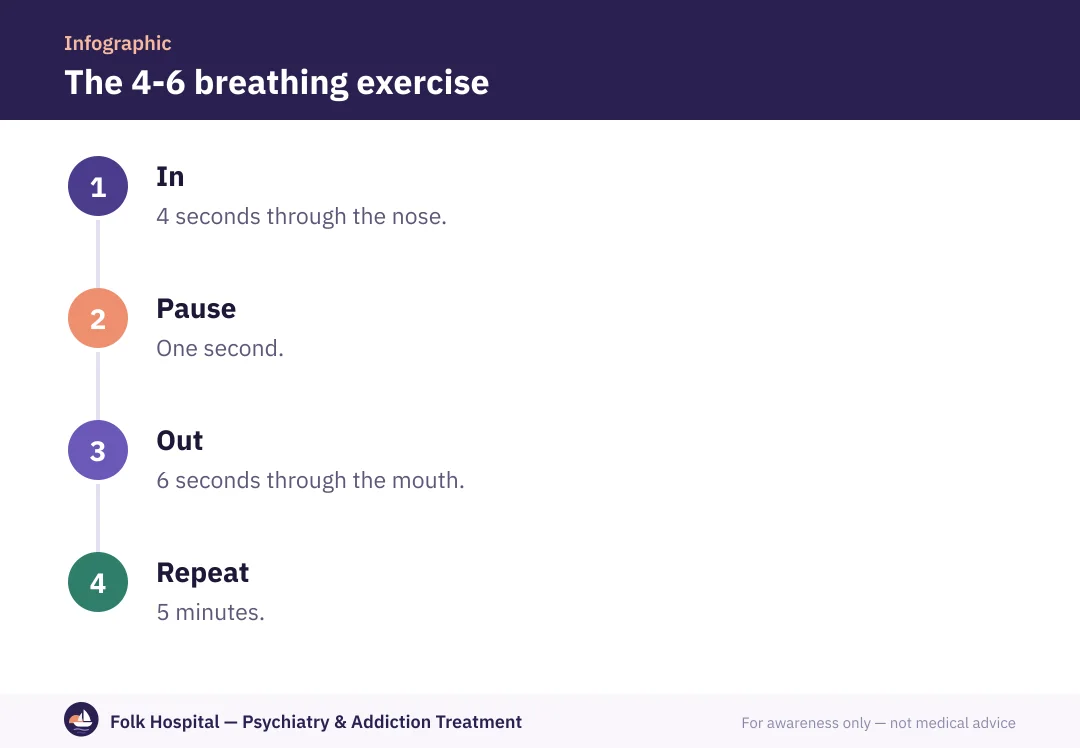
- Sitone hand on your belly.
- Breathe inslowly through the nose, belly rising.
- Breathe outlonger than the in-breath, through the mouth.
- Repeatfor several minutes.
- Severe chest pain or blue lips.
- Breathlessness worsening on exertion or in sleep.
- A first episode without diagnosis.
In Egypt call the ambulance on 123 immediately.
Ambulance: 123Read psychosomatic disorders and panic disorder.
؟Frequently asked questions
What is psychological breathlessness?
A feeling of not getting a full breath linked to anxiety or panic, after ruling out physical causes.
How do I know it's psychological?
After medical tests rule out asthma, heart and lung disease and anaemia.
What is hyperventilation?
Over-fast or over-deep breathing causing tingling, dizziness and palpitations.
How do I manage an episode?
Slow belly breathing, breathing out longer than in, and reminding yourself it will pass.
Is breathing into a paper bag useful?
It's not recommended without supervision; slow breathing is better.
When should I go to emergency?
With severe chest pain, blue lips, breathlessness on exertion, or a first episode without diagnosis.
Sources and references
- Panic disorder — NHS (UK)
- Generalised anxiety disorder (GAD) — NHS (UK)
- Somatic symptom disorder — MedlinePlus — U.S. National Library of Medicine — MedlinePlus

A psychiatrist specialising in addiction and mental illness in adults and adolescents, with a focus on dual diagnosis.
For awareness only — not a substitute for medical advice. Editorial policy · View profile