
01Detection by sample
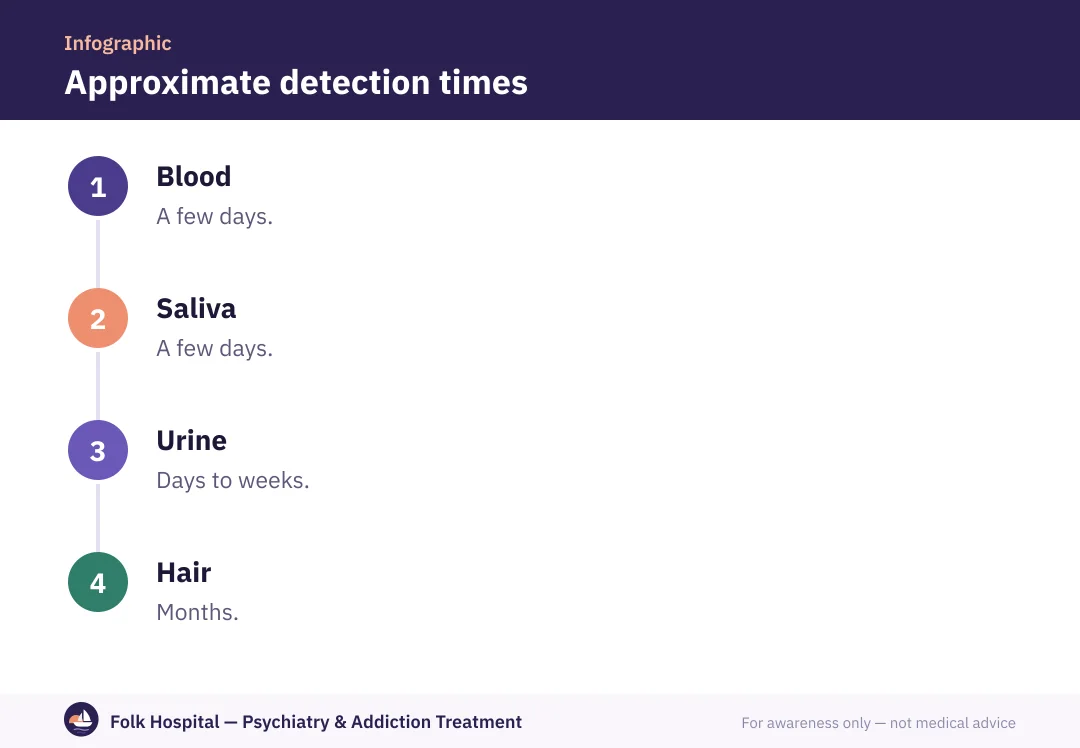
| Sample | Approximate detection |
|---|---|
| Saliva and blood | A few days |
| Urine | Several days, longer with heavy smoking |
| Hair | Months |
02What affects duration?
- Amount smokedmore lasts longer.
- Durationlong-term smokers retain traces longer.
- Metabolismvaries between people.
- Test typedifferent sensitivity.
Read also: smoking, drug testing, how long psychiatric medicines stay.
؟Frequently asked questions
How long does nicotine stay in the body?
Nicotine itself leaves quickly; cotinine can be detected for days in urine and blood.
Does smoking show in a urine test?
Yes, via cotinine for several days after the last cigarette.
Does hair reveal smoking?
Yes, for much longer than urine.
Does passive smoking show in tests?
It can give low levels, usually different from a smoker's.
Do nicotine patches show in tests?
Yes, they produce cotinine, though some tests distinguish other tobacco substances.
Can I speed up clearance?
There's no proven safe way; time is the main factor.
Sources and references
- Nicotine and tobacco — MedlinePlus — U.S. National Library of Medicine — MedlinePlus
- Drug Testing — U.S. National Library of Medicine — MedlinePlus

Written byDr. Mahmoud ElsawyConsultant in psychiatry and addiction treatment
A psychiatrist specialising in addiction and mental illness in adults and adolescents, with a focus on dual diagnosis.
For awareness only — not a substitute for medical advice. Editorial policy · View profile