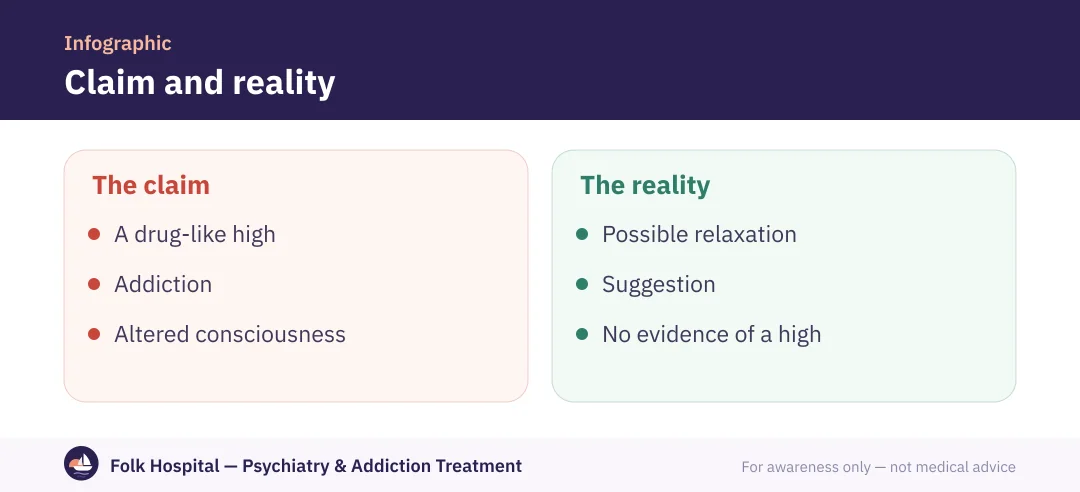
01Claim and reality
| Claim | Reality |
|---|---|
| Mimic drugs | No evidence |
| Cause addiction | No chemical addiction |
| Completely safe | Loud volume harms hearing |
| No risk | May open the door to curiosity |
Raises risk
- Exaggerated scaremongering
- Neglect
Protects
- Calm dialogue
- Monitoring content and friends
Read also: screen addictions, family guide, drugs.
؟Frequently asked questions
What are digital drugs?
Audio files with binaural beats claimed to mimic drug effects.
Do they really work?
Evidence doesn't support drug-like effects; there may be a mild relaxation effect.
Are they addictive?
No chemical addiction; listening may rarely become a compulsive habit.
Are they dangerous?
The risks are curiosity about real substances and loud volume.
What if my child listens to them?
Talk calmly about their motive and watch for signs of real drug use.
Do they have therapeutic use?
Some research studies them for relaxation, without an established recommendation.
Sources and references
- Binaural beats: a review (PMC) — U.S. National Library of Medicine — MedlinePlus
- Addictive behaviours: gaming disorder — World Health Organization

Written byDr. Mohamed HosneyConsultant in mental health and behavioural rehabilitation
A specialist in psychological rehabilitation, behaviour modification and relapse prevention, with over 15 years in addiction programmes.
For awareness only — not a substitute for medical advice. Editorial policy · View profile