01Key neurotransmitters
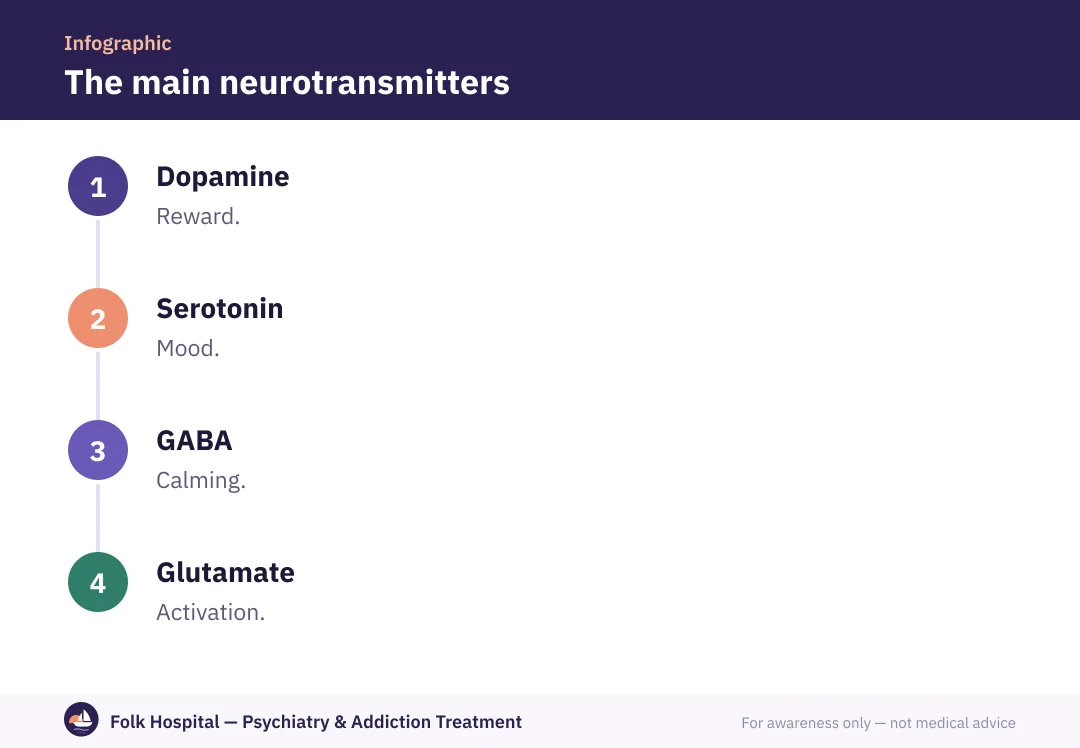
| Neurotransmitter | Type | Role |
|---|---|---|
| Glutamate | Excitatory | Learning |
| GABA | Inhibitory | Calming |
| Dopamine | Modulatory | Reward |
| Serotonin | Modulatory | Mood |
| Norepinephrine | Modulatory | Alertness |
| Acetylcholine | Varied | Memory and muscles |
| Endorphins | Peptide | Pain |
02A signal's journey
- Releasefrom the cell ending.
- Bindingto receptors.
- Signallingin the next cell.
- Terminationreuptake or breakdown.
Read also: types of brain chemistry, hormones, brain chemistry.
؟Frequently asked questions
What are neurotransmitters?
Chemical messages carrying signals between nerve cells.
How do they work?
Released into the synapse, they bind to receptors on the next cell, then are reabsorbed or broken down.
What is reuptake?
The return of the neurotransmitter to the first cell, which some antidepressants block.
How do drugs affect them?
By mimicking, increasing release, blocking reuptake or boosting receptors.
How many are there?
Dozens, with about ten best known.
Can they be measured?
Not accurately with simple blood tests.
Sources and references
- Neurotransmitters — Cleveland Clinic

Written byDr. Mahmoud ElsawyConsultant in psychiatry and addiction treatment
A psychiatrist specialising in addiction and mental illness in adults and adolescents, with a focus on dual diagnosis.
For awareness only — not a substitute for medical advice. Editorial policy · View profile