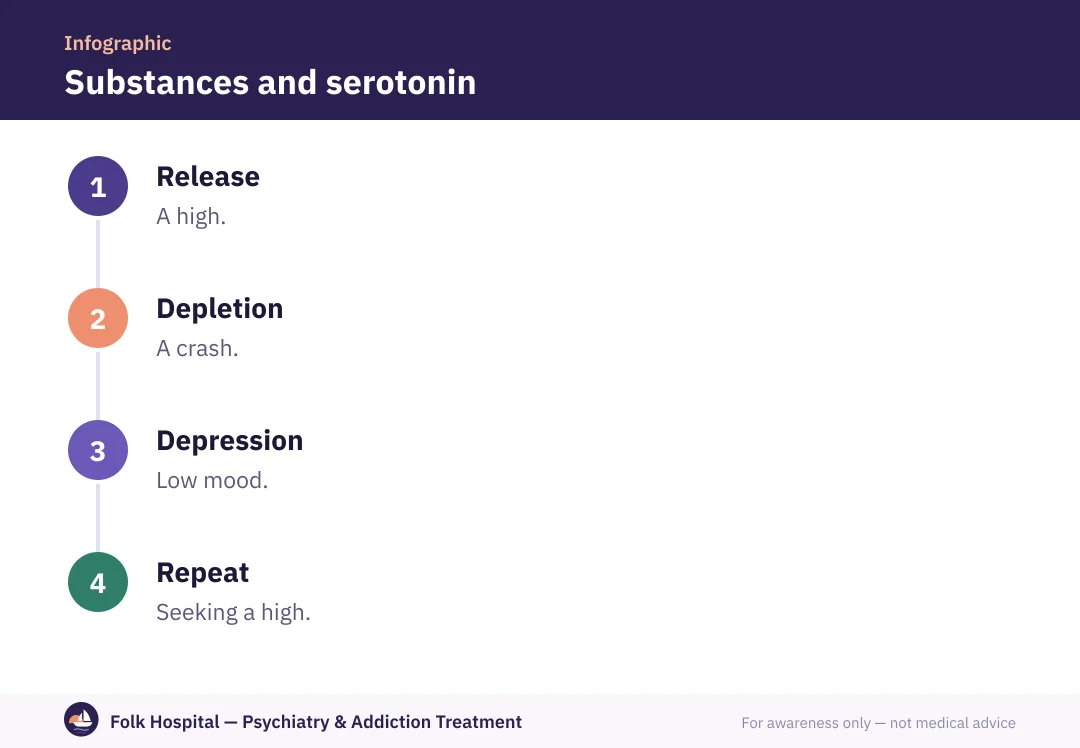
01Substances and serotonin
| Substance | Effect |
|---|---|
| Ecstasy | Strong release then crash |
| Hallucinogens | Receptor activation |
| Alcohol | Long-term disturbance |
| Stimulants | Indirect effect |
When to get help immediately
- Suicidal thoughts or intent to harm yourself or others.
- Losing touch with reality or severe agitation.
What to do right now
In Egypt call the ambulance on 123 or the mental-health hotline 08008880700.
Ambulance: 123Read also: serotonin, ecstasy, dual diagnosis.
؟Frequently asked questions
How is serotonin linked to addiction?
Some substances act on it directly, and its disturbances can drive use.
Why do I feel depressed after ecstasy?
Because of excessive serotonin release followed by a drop.
Are hallucinogens addictive?
Some are less physically addictive but carry psychological risks.
Do antidepressants help recovery?
They treat co-occurring depression and anxiety, not addiction itself.
Does alcohol affect serotonin?
Yes, and worsens depression long-term.
Is combining dangerous?
Yes. Ecstasy with antidepressants can cause serotonin syndrome.
Sources and references
- Serotonin — Cleveland Clinic
- Depression — National Institute of Mental Health (NIMH)
- MDMA (Ecstasy/Molly) — research topic — National Institute on Drug Abuse (NIDA)

Written byDr. Mahmoud ElsawyConsultant in psychiatry and addiction treatment
A psychiatrist specialising in addiction and mental illness in adults and adolescents, with a focus on dual diagnosis.
For awareness only — not a substitute for medical advice. Editorial policy · View profile